
Written by Hafsa Ahmed and Eleanor Suters
Photographed by Carlo Tolentino
On a midwinter morning in August, future play lab’s group of play designers, researchers, and placement students made our way to Geelong to host an urban play workshop. This workshop marked the start of a series of three Reworld Your Neighborhood events in Geelong, with this first event focused upon teasing out what community members might want Geelong to look like in 2050.
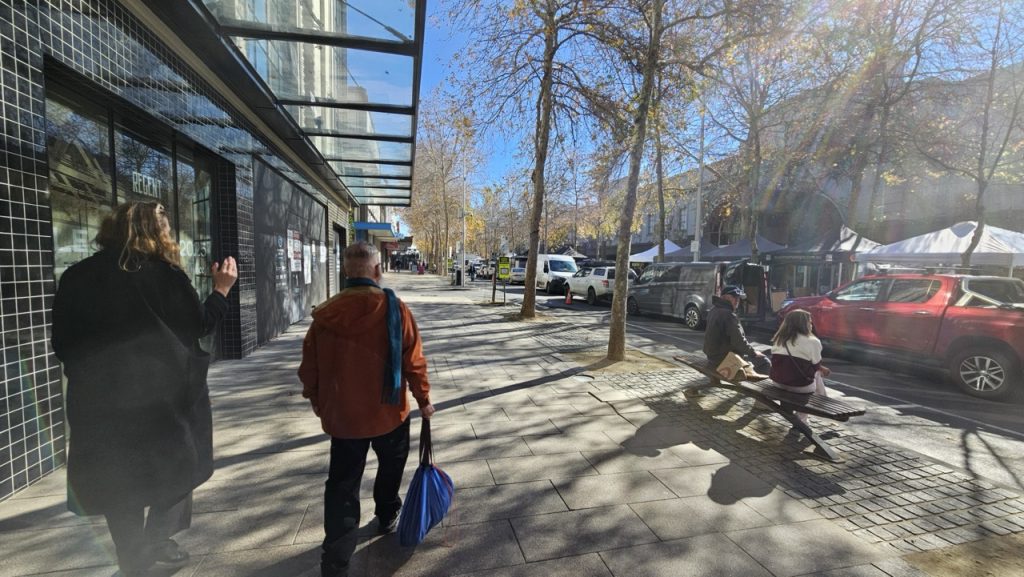
The research team is headed by A/Prof Troy Innocent – a play researcher, multidisciplinary artist, and the Director of future play lab. Dr Innocent was joined by creative director and multimedia designer Carlo Tolentino, as well as Ashleigh Dharmawardhana, who is a research assistant with a media and design background. Ilana was our local guide; she’s a sessional academic, curator, researcher and artist as well as Geelong resident. Professor Katherine Johnson, the Dean of RMIT’s School of Global, Urban and Social Studies, also joined the workshop. Playful Spaces Officers (PSOs) were played by play facilitators and Masters of Animation, Games and Interactivity students Saanya and Naddy. Rounding out the team were two Master of Social Work students on placement, Hafsa and Eleanor, who were there to assist with interviews and observations.
The decided venue was Geelong Library and Heritage centre – an imposing, spaceship-esque building painted in vibrant blue and pink pastel. The building has six levels including the ground floor: a cafe, video gaming consoles, regional archival materials and a zine vending machine coexist in this vast community meeting space set amongst Geelong’s coastal town backdrop. During set-up, some library-goers were curious about the play materials we had brought, and one young girl became interested in playing with the Lego.
We welcomed a small group of participants who arrived with plenty of enthusiasm and curiosity. Many of the participants had travelled from suburbs outside Geelong proper to attend this workshop. Some were in their twenties, some in their late teens, and others still were young children. This created an exciting and challenging group dynamic – in a good way!
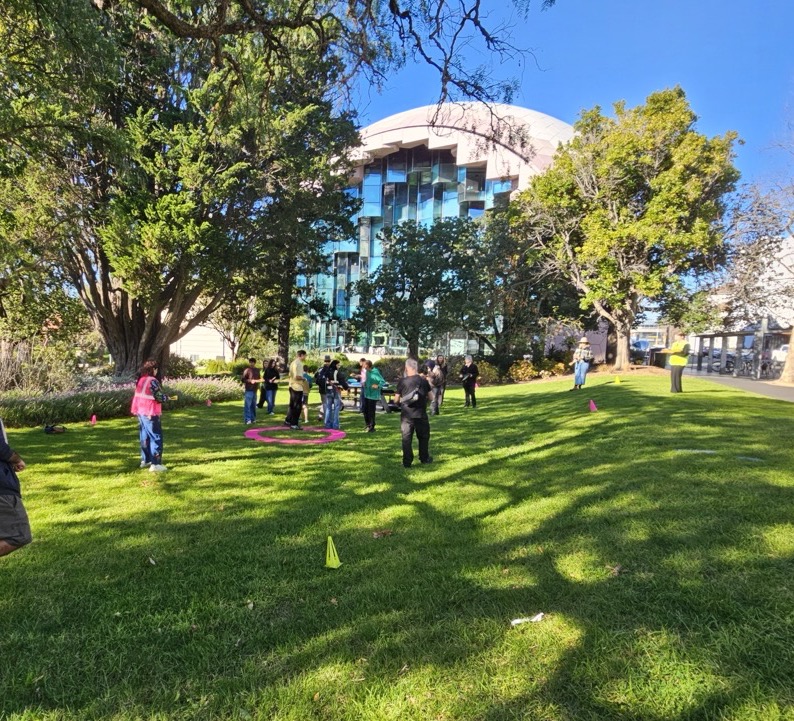
We began the afternoon outside in the garden park with some games to break the ice and get everyone comfortable with each other. The games kicked off under a crisp blue sky and long branches of an oak tree. We formed a circle and began a round of Fox and Squirrel: participants throw a soft soccer ball (the ‘Fox’) to one another while saying the name of the ball’s recipient. A hackey-sack (the ‘Squirrel’) is passed sideways around the circle. If a player has to catch the Fox while holding the Squirrel, the game ends. We then played several rounds of Lemon Joust, both individually and in teams. Participants held a lemon between two wooden spoons. If the lemon was knocked out of place in some way, the player was out. It was great to see how quickly participants began thinking outside the box, developing creative strategies to protect their own lemons while attacking others. Some participants ‘broke’ unwritten rules by holding onto the lemon with one hand. The creativity continued with Zen Counting, where participants quickly discovered ways to bend the rules by saying several numbers rapidly to help the group reach a higher number. These moments captured how we question existing rules when we’re playing in a group and find new ways to create fun.
After the outdoor games, we headed back into the library and divided into two groups. One group used building blocks and sensory materials to role-play their vision of Geelong in 2050, while the other used LEGO to physically build the future they wanted to see. As participants created, we discussed their experiences of urban play, their connections to Geelong and how they imagined the city in the future. One participant created a renewable energy centre, with a hydro-electric power plant and solar panel, as well as a ‘clean’ oil refinery. Their vision for Geelong in 2050 was a town focused upon energy efficiency. Another created a skyscraper, hoping for it to become a centre for innovation. Encouraging innovation, tourism and prosperity in Geelong seemed to be a desire for many people. One very young participant spoke about how she created ‘happy neighbours’ with a shared vegetable garden.
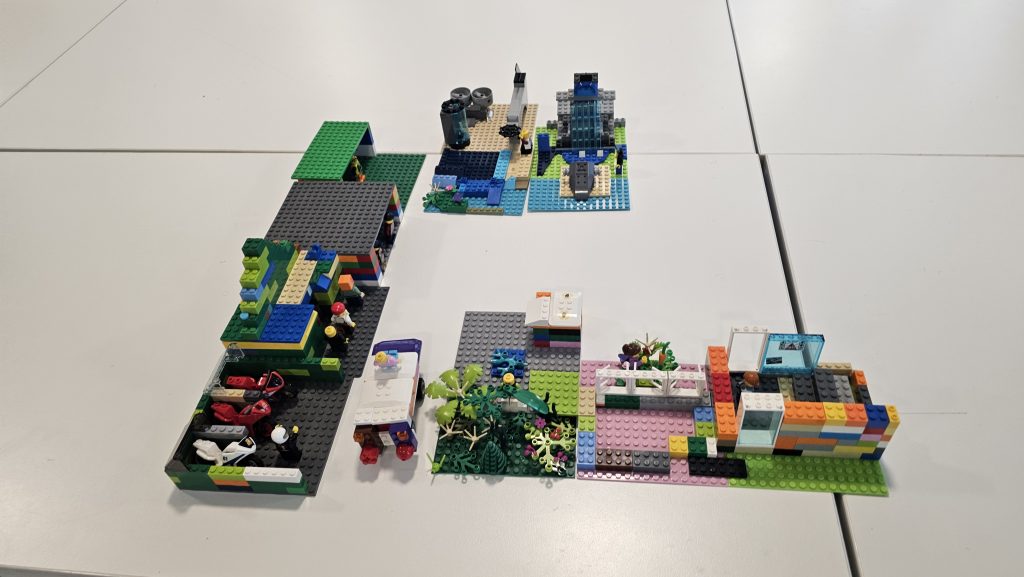
During the roleplay activity, some interesting themes emerged. Participants spoke about wanting more nature and third spaces, rather than a future dominated by manmade structures and buildings. There were ideas about architecture that could work alongside nature and spaces that could encourage people to connect with each other and their community. One participant used natural materials to create a maze, explaining that he would like to see mazes become more common in Geelong as spaces for play and exploration. At the end of the maze, he placed a marble representing hope, symbolizing the idea that although the path towards the future may not always be straightforward, there is still hope and possibility at the end.
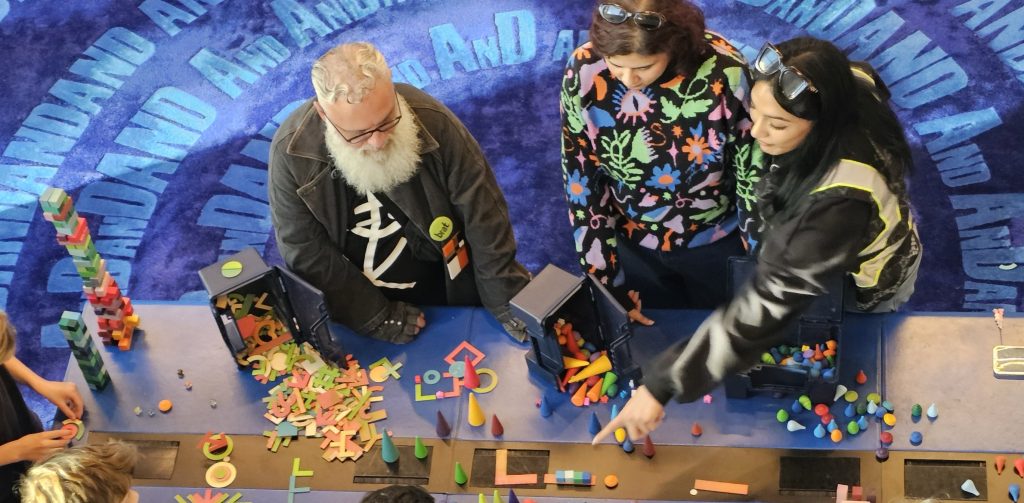
Artificial intelligence sparked plenty of conversation across both activities among older participants. People shared both excitement and anxiety about AI and debated what role technology might have in the Geelong community by 2050. While some agreed that AI’s use was necessary or ‘inevitable’, discussion surrounding trust in AI and its environmental impact was nuanced, with some expressing that while the previous group’s vision for Geelong seemed to lack incorporation of AI, AI was defined as a ‘foe’ by others.
One of the most interesting things about the day was seeing how play could make conversations about the future feel more accessible. Asking someone what they want their city to look like in 2050 can be a difficult question, but giving them LEGO, games and creative materials provides a different way to explore those ideas. The workshop demonstrated that young people have valuable perspectives on the future of their communities. Through playing, building, questioning and sometimes bending the rules, participants were able to explore what they valued about Geelong and what they hoped could change. Reworlding Geelong reminded us that imagining a different future doesn’t always have to begin with finding the right answer. Sometimes, it can begin by simply playing with what is possible.